

Indigenous Primary Care Collaboration & Patient Safety Research
This page shares current Indigenous health research projects led by Dr. Amrita Roy in partnership with the Frontenac, Lennox & Addington Ontario Health Team (FLA OHT), the Indigenous Wellness Council, and regional health system partners.
Her work examines how primary care structures can better reflect Indigenous priorities, governance, and definitions of patient safety. Through community-embedded qualitative research, these studies explore collaboration processes, promising practices in culturally safe care, and opportunities to strengthen Indigenous leadership in system transformation.
Centering Indigenous Perspectives and Priorities in the Frontenac, Lennox & Addington Ontario Health Team (FLA OHT)
Guided by the principles of Ownership, Control, Access, and Possession (OCAP) in ethical community-based Indigenous health research, the project examined collaboration processes between FLA Ontario Health Team (FLA OHT) and Indigenous partners.
The project involved an analysis of interviews with current and former Indigenous members of FLA OHT working groups and tables, focus groups with members of the Transitional Leadership Collaborative (TLC), and a review of FLA OHT organizational documents. The results point to five major themes for strengthening collaboration: growing Indigenous knowledge and relationships, creating Indigenous spaces, increasing Indigenous representation, catalyzing action, and obtaining additional funding and resources.
The research emphasizes the importance of action-oriented engagement, adequate resourcing, and responsiveness to Indigenous voices as conditions for collaboration to be experienced as meaningful by Indigenous partners. It also situates collaboration within broader organizational and policy contexts, drawing attention to the need for change at multiple levels.
In addition to the policy brief, a practice-focused toolkit was developed in partnership with the Indigenous Wellness Council: Indigenous Indicators for Health Systems: Toolkit of Indigenous-Focused Approaches and Evaluation Indicators for Health Systems (Frontenac, Lennox and Addington Ontario Health Team, Indigenous Wellness Council, and Roy, 2023). The toolkit brings together Indigenous-specific indicators, evaluation approaches, and reflective questions to support equity-oriented evaluation and the integration of Indigenous values, relationships, and community priorities into health system planning and transformation.
Scroll down to find addition FLA OHT publications, along with other projects!
CLICK THE THUMBNAILS FOR ACCESS!

Results in Brief
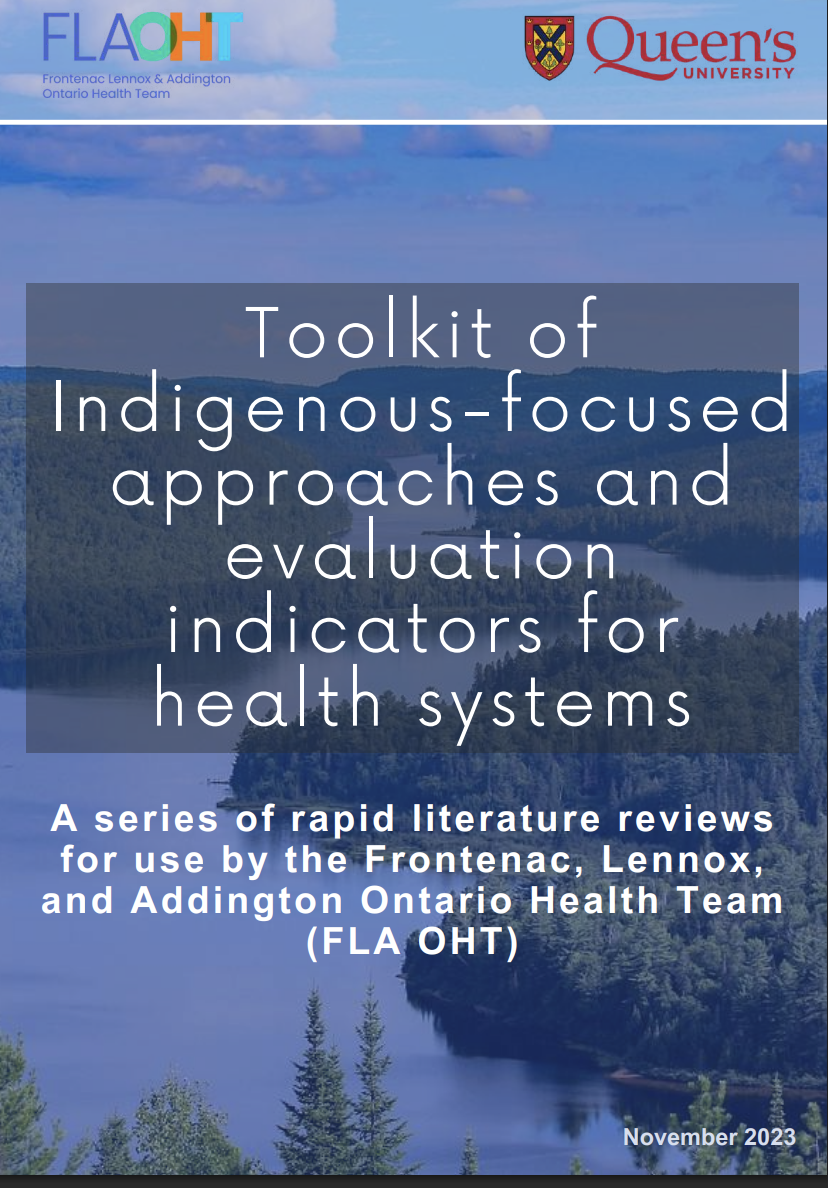
Toolkit

Final Report
Through a scoping review and focus groups with health system partners, this project gathers reflections on how promising practices for Indigenous patient safety are implemented in clinical settings. The work examines barriers and supports that influence culturally safe care, and how clinicians and administrators interpret their responsibilities in advancing Indigenous health equity.
The study is supervised by Dr. Roy and carried out by student researcher Natalie DiMaio, in collaboration with Kingston Health Sciences Centre and the FLA OHT. A report is expected in summer 2025.
Indigenous Patient Safety and Culturally Safe Care: Stakeholder Reflections

Report coming soon!
Check out Publications, Reports and More!
This section shares key publications from the research team led by Dr. Amrita Roy, examining how intergenerational trauma, pregnancy, and health systems change are understood and addressed in partnership with Indigenous communities.
Together, these works connect individual and family experiences of trauma with population health research and Indigenous-driven approaches to governance, evaluation, and policy in primary and integrated care.
We'd like to invite you to explore the resources below to learn more about the FLA Ontario Health Team and other evolving programs of work.
📌 Roy, A., et al. (2025). What Does Meaningful Indigenous Community Engagement Look Like? Examining Collaboration Processes in Health Systems Transformation in Southeastern Ontario (Canada). International Journal of Integrated Care, 25(S1), 579.
🔗 https://doi.org/10.5334/ijic.ICIC24579
This workshop abstract reports on a case study of Indigenous engagement within the FLA Ontario Health Team. The team documents barriers such as tokenism and slow, unclear processes, and identifies conditions that support meaningful collaboration, including relationship-building, Indigenous spaces and representation, honouring community time, and moving from consultation toward concrete action.
📌 Roy, A., et al. (2024). Race as a Determinant of Prenatal Depressive Symptoms: Findings from a Prospective Cohort Study in Alberta, Canada. Ethnicity & Health, 29(3), 395–422.
🔗 https://doi.org/10.1080/13557858.2024.2312420
Using data from the All Our Families longitudinal cohort, this study examines how race, socioeconomic factors, and social support relate to depressive symptoms in pregnancy. The analysis shows that racialized women, including Indigenous participants, experience a disproportionate burden of prenatal depression even after accounting for income and other confounders, illustrating the need for anti-racist and trauma-informed perinatal mental health services.
📌 Roy, A., et al. (2023). Collaboration with Indigenous Communities in an Integrated Care Learning Health System in Ontario, Canada: A Case Study of the Frontenac, Lennox & Addington Ontario Health Team. International Journal of Integrated Care, 23(S2), ICIC23199.
🔗 https://doi.org/10.5334/ijic.ICIC23199
This case study describes how the FLA Ontario Health Team works with Indigenous communities to co-design governance and Indigenous-specific evaluation activities. The project uses community-based participatory research and OCAP principles to develop Indigenous-focused indicators and governance processes that can guide other integrated care systems.
📌 Roy, A., Noormohamed, R., Henderson, R., & Thurston, W. (2015). Promising Healing Practices for Interventions Addressing Intergenerational Trauma Among Aboriginal Youth: A Scoping Review.
🔗 First Peoples Child & Family Review, 10(2), 62–81.
This scoping review maps youth interventions in Canada, the United States, Aotearoa New Zealand, and Australia that respond to intergenerational trauma among Indigenous youth. Promising elements identified include cultural continuity, Indigenous world-views, community governance, and holistic models of wellness. Major gaps are described as rigorous evaluation and long-term funding for youth healing programs.
📌 Roy, A. (2014). Intergenerational Trauma and Aboriginal Women: Implications for Mental Health during Pregnancy.
🔗 First Peoples Child & Family Review, 9(1), 7–21.
Drawing on literature from psychology, public health, and Indigenous scholarship, this paper explains how intergenerational trauma shapes the mental health of pregnant and parenting Indigenous women. It argues that pregnancy is a crucial intervention point, and calls for programs that pair culturally grounded healing practices with trauma-informed clinical care, in settings that are explicitly safe for Indigenous women.
Partnerships & Community Engagement
Dr. Roy’s Indigenous health research is grounded in sustained collaboration with regional partners. Her work with the Indigenous Wellness Council, the FLA OHT, and Kingston Health Sciences Centre reflects an ongoing commitment to community-led guidance, ethical research practice, and the shared goal of improving primary care for Indigenous peoples in southeastern Ontario.
For more information on these projects, please contact Principal Investigator Dr. Amrita Roy at amrita.roy@queensu.ca.